
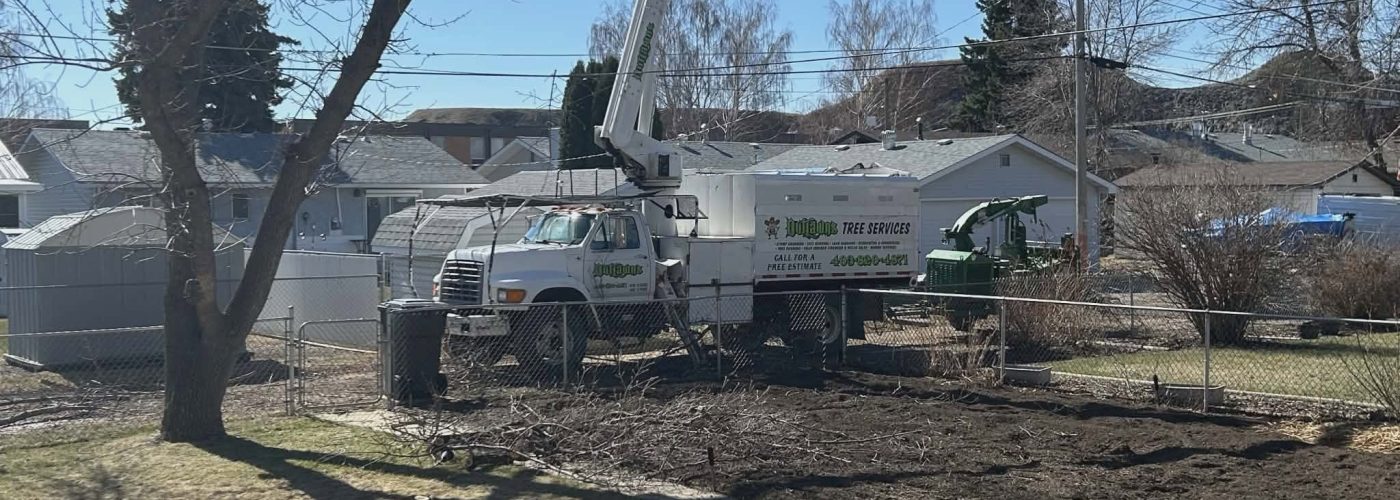
Most homeowners only think about their trees when something goes wrong. A branch comes down in a summer windstorm, a spruce starts browning out, or a dead poplar starts leaning toward the garage. The truth is, good tree care in Red Deer comes down to timing. Our central Alberta seasons are short and hard on trees, and doing the right job at the right time of year saves you money, protects your property, and keeps your trees healthy for decades.
Here is a season by season look at when to prune, trim, remove, and care for the trees in your yard.
Late Winter (February to March): The Best Time to Prune Most Trees
If you only book one tree job a year, late winter is the time to do it. Trees are dormant, so they are not putting energy into leaves or new growth. Pruning cuts heal quickly once spring arrives, and there are no active insects or fungal spores looking for an open wound.
Without leaves, it is also much easier to see the shape of the tree. Our crew can spot crossing branches, weak joints, and deadwood that would be hidden in July. For mayday, chokecherry, and Schubert chokecherry trees, dormant season is also the right time to cut out black knot, a fungus that shows up in a lot of Red Deer yards.
Frozen ground is another bonus. Bucket trucks and equipment can get closer to the tree with far less damage to your lawn and flower beds.
Spring (April to June): Inspect, Clean Up, and Plant
Spring is when you find out how your trees handled winter. Look for branches broken by heavy snow, bark chewed by rabbits and mice, and cracks in the trunk. Dead or damaged limbs should come out as soon as you see them, no matter the season.
Hold off on heavy pruning of maples and birch in early spring. They push a lot of sap this time of year and will bleed from fresh cuts. It usually does not harm the tree, but it is messy and adds stress. Wait until the leaves are fully out.
Spring is also the best time to plant new trees. It gives the roots a full growing season to settle in before freeze up.
The Elm Pruning Ban: April 1 to September 30
If you have an elm on your property, this one matters. Alberta prohibits pruning elm trees between April 1 and September 30 to slow the spread of Dutch elm disease. The beetles that carry the disease are drawn to fresh cuts. Elms should only be pruned from October through March, and the wood has to be disposed of properly. Our team follows these rules on every elm we work on.
Summer (July to August): Storm Prep and Light Trimming
Central Alberta summers bring thunderstorms, hail, and strong wind gusts. The trees that cause damage are usually the ones with dead limbs, heavy overgrown canopies, or branches hanging over the roof. Light trimming in summer can thin out a crowded canopy and lift branches away from your house, fence, and power lines.
Summer is also a good time to watch for signs of trouble. Leaves wilting early, thinning crowns, mushrooms at the base of the trunk, or sawdust and small holes in the bark can all point to disease or insects that need a closer look.
Keep pruning light during hot, dry spells. A stressed tree does not need to lose a big part of its canopy in the middle of a drought.
Fall (September to November): Water Deep and Plan Removals
Fall is easy to overlook, but it sets your trees up for winter. Give your trees a deep watering before the ground freezes, especially evergreens. Spruce and pine keep losing moisture all winter, and a dry fall is one of the most common reasons we see brown needles in the spring.
Once the leaves drop, it is a great time to have a professional look over your trees. Hazard trees, dead poplars, and trees growing too close to the house can be spotted and scheduled for removal before winter snow load turns them into an emergency. Fall is also a smart time for stump grinding and stump removal while the ground is still workable, so your yard is ready for new sod or a garden bed in the spring.
Winter (December to January): Removals and Emergency Work
Many people are surprised to learn that winter is a great time for tree removal. With the ground frozen solid, heavy equipment leaves almost no marks on the lawn, and the crew can work around gardens without trampling them. Scheduling is often more flexible too, since spring and summer book up fast.
Of course, if a heavy snowfall or windstorm drops a branch on your roof or driveway, do not wait for the right season. Call right away.